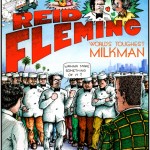
There’s been a resurgence of interest online in 60s-style commercial design, that really evocative screen-print business with the deep cool colours, the kind of stuff Saul Bass made a name for himself with. In the spirit of the zeitgeist (wow, did I just say “in the spirit of the spirit?”) I’ll share the cover of a vintage book I just bought. I read about it on Ethan Iverson’s blog one fine Saturday morning, in this post on Hal Overton, and immediately tracked down a copy on Abebooks and ordered it.
Heist (2001) is a daunting subject for analysis, as is its writer and director David Mamet. It is an example of what I call “semantic screenwriting,” in that it demonstrates that you can put pretty much any nonsensical line into Gene Hackman’s mouth and tell him to spit it back out as if it is the cleverest thing anyone in the room has heard all day, and people will likely assume that it is in fact a juicy bon mot that they just didn’t get.
This kind of writing makes for very pithy quotes, but take it from someone whose favourite pastime is coming up with his own pithy things to say and then saying them to real live people. My experience in this regard, in particular my familiarity with l’esprit de l’escalier, means that the disbelief I must suspend while watching Mamet is doubly heavy. Firstly, no one talks like that, at least not in real time. Secondly, if people did talk like that, the people they were talking to wouldn’t just nod appreciatively. They’d say, “What are you talking about? That makes no sense.”
That the movie works on this semantic level says a lot about Hackman’s talent (and to a lesser degree that of his co-stars Delroy Lindo, Danny DeVito and perennial Mamet favourite and sometime magician Ricky Jay) and Mamet’s audacity, but little else. And it has been a while since I saw the movie, but I recall Mamet also devotes a lot of screen time to characters discussing how hot the Hackman character’s wife is, and if you know as I think most of us do that the actor playing that part is Mamet’s wife Rebecca Pidgeon, those frequent departures tend to grate on the ear after a while. The fact that Pidgeon’s wooden acting makes your average cigar store Indian look like Alan Arkin doesn’t help matters either.
There is however one real gem in there among the head-scratching non sequiturs – e.g. “Everyone wants money… that’s why they call it money” and “My man is so cool, sheep count him” – and I think it must give fiction writers pause, wondering whether Mamet is offering us a glimpse into his own thought processes. Hackman’s character, Joe, is refuting the D.A.’s assessment of him as a “pretty smart fella.”
JOE: Ah, not that smart.
D.A.: If you’re not that smart, how’d you figure it out?
JOE: I tried to imagine a fella smarter than myself. Then I tried to think, “what would he do?”*
My only support for this argument is that I never gave it so much thought as when I began writing fiction myself, and had to come up with the name of a character whose parents are wildly intelligent and creative people (I have yet to come up with one). The problem will worsen when it comes time to put words in all their mouths. I’ll be in Joe’s position, trying to think of what people who are smarter than I would do.
While I’m at it, I’ll try to think of what kind of things people with really interesting lives might get up to, and what kind of things happen to people who experience awe-inspiring, life-altering events.
Wish me luck.
*This is very reminiscent of another famous Mamet tautology. I have yet to track down an interview in which this exchange actually occurs, but in his book Writing in Restaurants he claims, “People always ask me where I get my ideas. I always tell them that I think of them.”
…on the History Channel. It’s their answer to Shark Week, I suppose. I’ve still managed to avoid both the movie and the book, though I did accidentally read The Holy Blood and the Holy Grail, one of whose co-authors appears, dressed like D-Day from Animal House, in this evening’s greasily compelling conjectumentary Beyond the da Vinci Code. So while I figure out how to create a podcast with my DAW looking like this, I’ll leave you with the brilliant Andrew Maxwell’s review of Dan Brown’s bafflingly popular tome.
Not knowing why you’re doing what you’re doing, while you’re doing it: isn’t that madness? Holding on to a slime-covered rock at the bottom of a lake, pondering the balance between the weight of sodden corduroy and cotton and the buoyancy of your lungs and the water sliding under your belly to wedge you up, under your chest, telling you this is silly, that it’s a little thing, they’re your friends, let go. Come back up. Float back up to the surface. Put your shoes back on. Everything will be forgiven. It’s just a ring stamped out of nickel and chrome. They’ve got dozens. Hundreds. The secretary keeps the extras in a cardboard box in a desk drawer behind a lock you could pick with a bent paper clip. Let go.
“I’ll get it.” Ian forced a laugh, a shrug. As if it was nothing. And wasn’t it? More silence, more crying. Dave shook his head slowly, his lips pulled tight into a line.
“Look.” He pulled off a Topsider, hopping backward on one foot while he tugged on a sock. “I’m getting it. I’ll get it.” He reached down to the bottom button on his shirt, still hopping. He glanced at Jennifer. It’s nothing they don’t see when you’re swimming, he told himself. But he hadn’t been swimming with Jen since they were kids, and that was a lifetime ago.
Then somewhere between the shirt button and the other shoe she was coming at him. He couldn’t understand what she was screaming. It started with “You!” and disintegrated from there. He couldn’t run, holding his left foot in two hands and jumping around on his bare right one. Wouldn’t have, moreover. He wanted her on him, pounding on his bony chest with her fists.
But she only got far enough to push him onto his ass and swing a wild slap that didn’t connect. Dave ran in and stopped her midway, picked her up off her feet from behind. Ian tried to laugh but the fall had knocked the wind out of him. When his tailbone hit the ground he’d felt it in his molars. And now he was crying too. He rolled over and started crawling toward the lake, then launched himself into a sprint. He tried to remember where he’d thrown it, diving in, picturing an Olympic dive that sliced through the water gracefully, but feeling a clumsy bellyflop, and clothes that were suddenly like a packing blanket around him.
“Come on, let’s see it.”
Jen was smiling, dangling the ring on a thin gold chain. “You see with your eyes, not with your hands,” she taunted him, but she was already reaching around for the clasp. Ian caught Dave’s eye and he nodded. And then it started and it was like they were playing from a script. Keep away. Monkey in the middle. She was angry but not really angry. Everyone was laughing.
A losing entry in the 4th Annual Geist Literal Literary Postcard Story Contest.